- Posted By Admin
- Dec 10, 2025
In today’s digital business environment, organizations rely on a wide range of service providers—cloud platforms, cybersecurity vendors, application support teams, managed service providers, and more. While this multi-vendor ecosystem offers flexibility and specialized expertise, it also creates challenges such as miscommunication, duplicated efforts, unclear responsibilities, service delays, and operational risks.
To manage these complexities effectively, organizations turn to Service Integration and Management (SIAM). SIAM acts as a governance and coordination framework that ensures multiple providers work together seamlessly as one unified system. Many professionals also wonder how SIAM differs from ITIL, whether they need ITIL knowledge first, and how SIAM boosts career growth. This article answers all these questions by explaining SIAM concepts, principles, benefits, roles, challenges, and real-world applications.
By adopting SIAM, organizations improve collaboration, reduce service gaps, and ensure consistent service delivery—regardless of how many vendors are involved. This article explains what SIAM is, why it matters today, how it works, and how SIAM Foundation Certification from UpgradeMySkill helps professionals elevate their IT service management capabilities.
Service Integration and Management (SIAM) is a methodology designed to integrate, coordinate, and manage multiple service providers so they deliver IT services as one cohesive ecosystem. Traditional IT management focuses on internal processes and individual teams. SIAM, however, focuses on end-to-end service delivery across all vendors working for an organization.
The main goal of SIAM is to ensure that IT services are reliable, consistent, and aligned with business objectives—even in complex multi-provider environments.
Typical SIAM objectives include:
With SIAM, organizations overcome challenges like siloed operations, inconsistent service delivery, and poor coordination—creating a unified and streamlined IT environment.
As organizations increasingly adopt cloud platforms, outsourced IT services, and specialized vendors, traditional IT management frameworks struggle to provide the required level of control and integration. This leads to inefficiencies, miscommunication, and operational risks.
SIAM solves these challenges by offering a structured framework for governance, integration, and collaboration across all providers.
SIAM enables organizations to:
Industries like finance, healthcare, government, IT services, and telecom benefit greatly from implementing SIAM due to the complexity of their multi-vendor ecosystems.
SIAM is built on guiding principles that ensure effective service delivery across multiple providers:
Together, these principles help organizations manage complex service environments effectively.
SIAM operates through a multi-layered model that defines how customers, integrators, providers, and users interact:
This layered structure ensures alignment, clarity, and consistent service delivery across all vendors.
SIAM clearly defines roles to eliminate confusion and improve accountability:
This role clarity reduces operational risks and strengthens collaboration across providers.
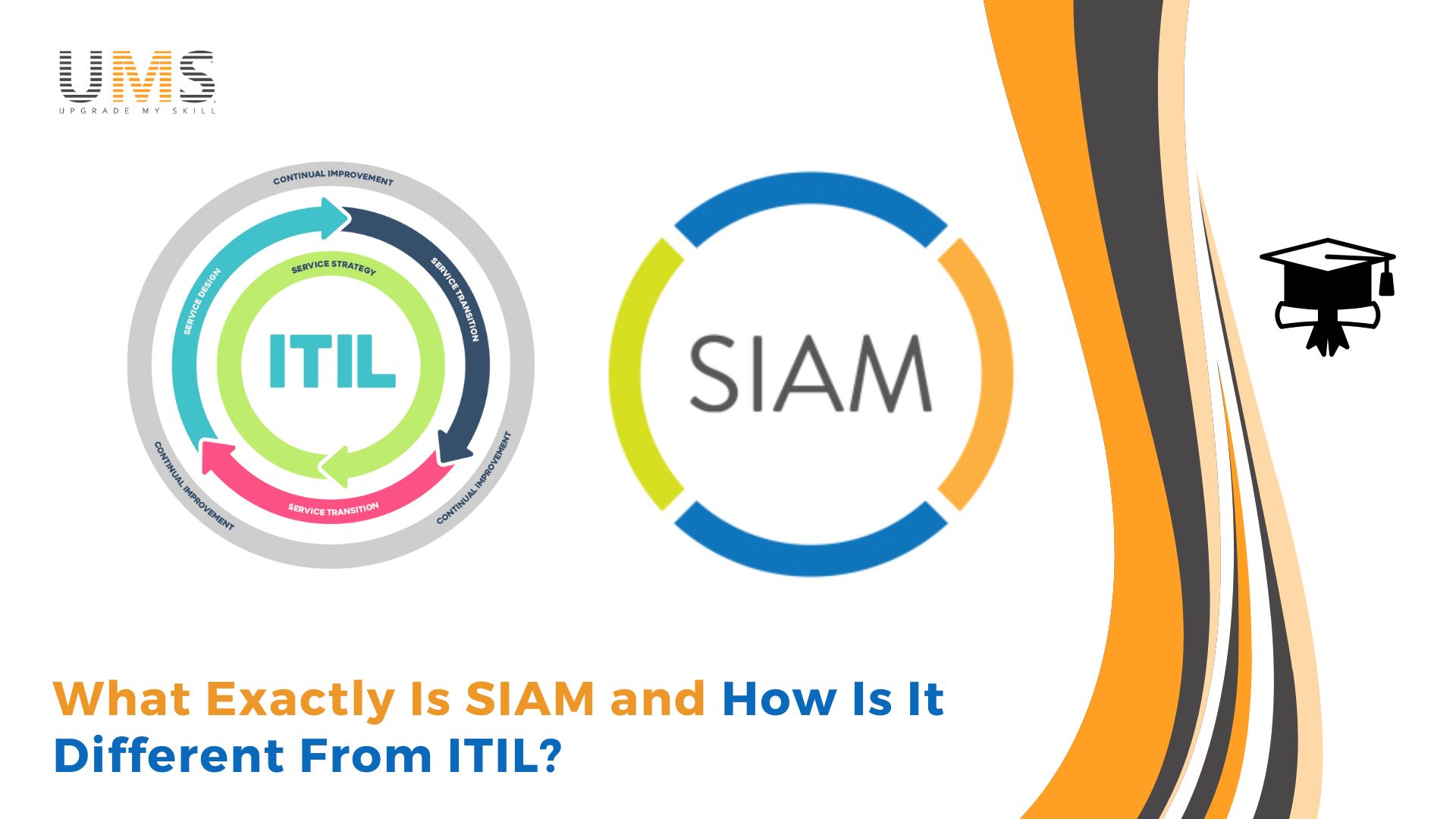
SIAM and ITIL are often confused, but they serve different purposes:
In essence, ITIL defines the processes, while SIAM ensures these processes work seamlessly across all providers.
Organizations that implement both frameworks gain maximum efficiency, governance, and service reliability.
SIAM is used across industries that depend on multiple vendors:
These examples demonstrate SIAM’s ability to streamline complex environments and improve service outcomes.
Implementing SIAM requires addressing several challenges:
Successful SIAM implementation requires leadership support, clear governance, effective training, and continuous improvement.
1. Do I need ITIL knowledge before SIAM?
Helpful but not mandatory.
2. Is SIAM only for managers?
No, analysts, consultants, and process owners also benefit.
3. Is SIAM globally recognized?
Yes, SIAM Foundation is widely accepted.
4. Can small organizations use SIAM?
Yes—principles can be applied selectively.
5. How long does SIAM exam preparation take?
Typically 2–4 weeks.
SIAM is an essential framework for managing complex multi-vendor IT environments. It enhances collaboration, accountability, service quality, and operational efficiency. While ITIL strengthens internal processes, SIAM integrates those processes across all providers for consistent and seamless service delivery. Professionals with SIAM expertise are in high demand across IT service management, consulting, and operations roles.
If you're ready to master SIAM and gain globally recognized credentials, consider enrolling in the SIAM Foundation Certification Training at UpgradeMySkill.
Enroll Today: Advance your IT service management career with SIAM Foundation Certification.
In 2026, enterprise IT environments have become more complex than ever. Organizations are embracing hybrid multi-cloud strate...
This article provides a comprehensive overview of SIAM (Service Integration and Management) and its growing importance in man...
This article explores how Lean Six Sigma drives operational excellence across IT, manufacturing, and healthcare by improving...